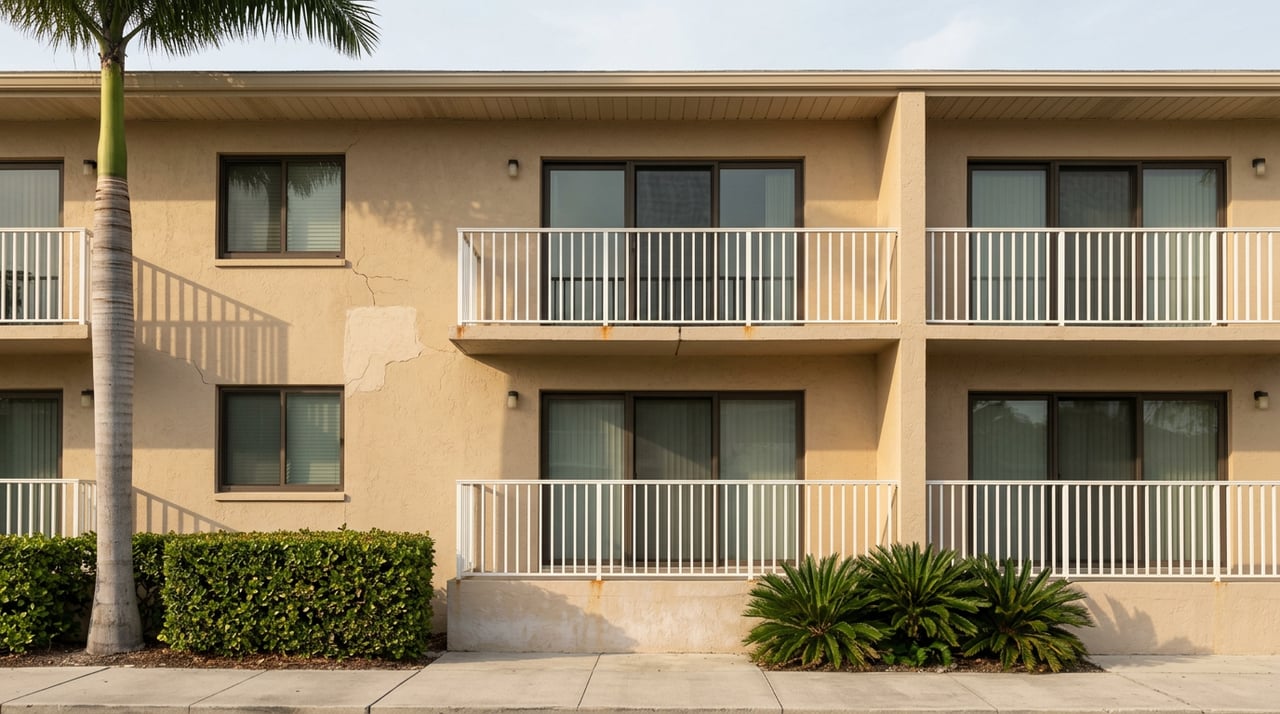
The Real Cost of a South Florida Beachfront Condo Isn't the Listing Price
August 20, 2026
August 20, 2026
Two units. Same building, same floor plan, same ocean view from the balcony. One is listed forty thousand dollars below the other. A buyer's first instinct is to call that a deal.
It might not be. It might be the honest price of a building that hasn't finished paying for its own future.
That gap is showing up across the Palm Beach County beach corridor this year, and it has almost nothing to do with the unit itself. It has to do with a document most buyers never think to ask for: the building's Structural Integrity Reserve Study, known as a SIRS. As of this month, how that document reads determines not just what a condo costs to own, but whether a lender will finance it at all.
Florida's condo safety rules trace back to the collapse of Champlain Towers South in Surfside on June 24, 2021, which killed 98 people. The legislature responded with Senate Bill 4-D in 2022, refined in 2023, requiring any condo or co-op building three habitable stories or taller to complete a milestone structural inspection and a Structural Integrity Reserve Study. The milestone inspection checks the building's physical condition. The SIRS is the financial side: it inventories the roof, load-bearing structure, fire protection, plumbing, electrical, waterproofing, and windows, then calculates how much the association needs to be saving each year to replace them before they fail.
For decades, Florida condo boards could vote to waive that saving and keep monthly dues artificially low. That option closed for good on January 1, 2026. Reserve funding for the eight SIRS-covered components can no longer be waived or reduced by owner vote, and that mandate is already in effect. Buildings that spent years underfunding their reserves are now legally required to catch up all at once, and the catch-up is landing as special assessments that have run anywhere from ten thousand to well over a hundred thousand dollars per unit in cases reported elsewhere in South Florida.
The milestone inspection itself is triggered by age, not by choice. A building must complete its first inspection at 30 years old, or at 25 years if it sits within three miles of the coastline, then every ten years after that. Palm Beach County's beach cities built heavily through the 1980s and into the early 1990s, which means a meaningful share of the county's oceanfront and Intracoastal-adjacent condo stock in Boca Raton, Delray Beach, and Boynton Beach is now sitting inside that 25-year coastal window, some of it for the second time.
Florida's law explains why a building might owe money. A separate, quieter change explains why a buyer's loan might not close at all.
On March 18, 2026, Fannie Mae issued Lender Letter LL-2026-03 and Freddie Mac published a matching bulletin the same day, coordinating a tightening of condo project standards nationwide with particular weight in Florida. Three pieces of that letter matter to anyone shopping the beach corridor right now:
A buyer touring condos this month is underwriting into a stricter environment than someone who did the same search in the spring. The building, not just the borrower, gets reviewed line by line.
Every guide to this topic eventually lands on the same phrase: percent funded. It is the ratio of what a building has actually saved against what its SIRS says it should have saved by now, and it is a faster read on real risk than the HOA fee.
| Percent funded | What it generally signals |
|---|---|
| Under 30% | Significantly underfunded. A special assessment is likely, not hypothetical. |
| 30% to 70% | Fair. Expect measured dues increases as the association works toward compliance. |
| 70% and above | Strong. Lower odds of a surprise bill in the near term. |
A low HOA fee used to read as a selling point. In 2026 it reads as a question. If a three-story-plus building's fee looks unusually gentle for its age, the honest next question is what its reserves look like, not what the view costs.
Palm Beach County runs 47 miles from Boca Raton to Jupiter, and its condo stock does not age the same way in every stretch of it. A Singer Island oceanfront tower faces different salt exposure and code requirements than an inland Wellington community, which is why the county's own enforcement snapshot matters more than a statewide average. A count from unincorporated Palm Beach County in early 2025 identified roughly 663 buildings subject to the milestone inspection requirement, with about 124 still owing their initial Phase 1 filing at that point.
Local repair costs give the SIRS numbers weight rather than leaving them abstract. Palm Beach County benchmarks put roof replacement around eight to sixteen dollars per square foot, concrete restoration at eighteen to forty-five dollars per square foot, plumbing riser replacement at eight to fifteen thousand dollars per unit, and impact-rated window replacement at five hundred to eighteen hundred dollars per opening, with oceanfront towers on Palm Beach Island and Singer Island typically running higher due to salt exposure and limited contractor access. Multiply any of those line items across a hundred-plus unit building and the arithmetic behind a six-figure assessment stops feeling abstract.
The county is also home to some of Florida's largest age-restricted condo communities, including Century Village, Kings Point, and Wynmoor, where hundreds of individual buildings each carry their own SIRS obligation calibrated to their own age and exposure. A buyer looking at a unit in one of these communities is not evaluating one reserve study. They are evaluating whichever specific building that unit sits in.
A buyer working through a coastal condo purchase right now should request, in order:
Associations with 25 or more units are now required to post governing documents, budgets, and reserve studies through an online portal under Florida's transparency rules, and owners have a legal right to view a completed SIRS or milestone report within 30 days of its completion. If a listing agent cannot produce these quickly, that delay is itself useful information.
A building that has completed its SIRS, funded its reserves, and cleared its milestone inspection is not a compliance footnote anymore. It is a competitive advantage over the identical unit two buildings down that hasn't done the same work. If your building has that paperwork in order, lead with it in your listing rather than burying it in the disclosure packet. If a special assessment has already been voted and recorded, Florida law generally requires it to be disclosed to buyers before closing, and the honest move is to price around it rather than hope it goes unnoticed during the buyer's own document request.
Does a clean milestone inspection mean the reserves are fine? Not necessarily. The milestone inspection is a physical safety check. The SIRS is the financial plan. A building can pass its structural inspection and still be significantly underfunded on the money side.
If I buy today, do I inherit an assessment that hasn't been levied yet? If it's already been voted and recorded, it typically follows the unit and becomes the new owner's obligation unless the contract says otherwise. If it's only under discussion in board minutes, it isn't yet a legal liability, but it's worth pricing into your offer.
Does any of this apply to a brand new building? The SIRS requirement is triggered by building height, not age, so a condo delivered this year still needs one on file. The milestone inspection's age trigger won't apply to it for two and a half decades, which is one reason new construction is drawing buyers who want to avoid inheriting a 30-year reserve catch-up.
The listing price was never the whole number. In 2026, along this stretch of coast, the real number lives in a report most buyers still forget to ask for.
If you're weighing a coastal condo purchase or sale anywhere from Boca Raton to Palm Beach, I'll help you get the SIRS, the milestone report, and the real financing picture before you write an offer or set a list price. Reach out to A+ Realtor and let's get it right the first time.
Stay up to date on the latest real estate trends.



Embarking on a real estate journey can be daunting, but you don't have to do it alone. With my unique blend of educational insight and real estate expertise, I'm here to guide you through every step, ensuring a smooth, informative, and successful experience. Ready to get started? Contact me today, and let's make your real estate dreams a reality.